
Walter Benjamin
There's supposedly a story (read it in a magazine) in Orson Wells' documentary "F Is for Fake" (haven't ever been able to finish this movie) about Picasso getting swindled by a woman who modeled for him. In this story (probably apocryphal?), Picasso paints a number of pictures of this woman during a marathon modeling session; she then talks him into giving her the paintings, and Picasso learns soon thereafter that she has opened a gallery and is offering them up for sale; it turns out, however, that these paintings are forgeries, copied by the woman's uncle, who, after having made the fakes, burned the originals in a fire. The question is, then, what value do these fakes have? It's an interesting question to ask. If a machine reproduces Jerry Siegel and Joe Shuster's drawings (originals long since gone?) of Superman in a magazine called Action Comics #1 and there are only 5 known good-condition copies left in the world of said magazine, what value does this magazine have? $1.5 million? Is it a work of art? Are copies of it works of art?
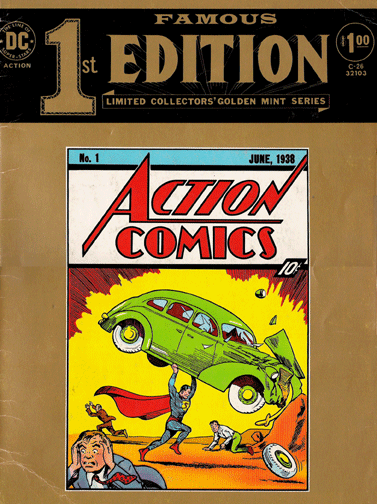
I made some comments in one of Blaises's recent posts about how I like making comics as opposed to art objects because:
"the objects the art world manufactures seem so puffed up. Comics are just what they are. You can draw (or paint or collage, etc) something and reproduce it infinitely so that everyone can enjoy the content of it. The content is not tied to historicity; comics have no mysterious power as individualized objects like paintings, sculptures, assemblages. I like those things, too, but I love how humble comics are. I think this is what Blaise and I are trying to say when we talk about comics on the computer - they're so much closer to pure content."
then I say other crap like:
"I totally feel like comics can be capital A art. I feel like they're similar to music and movies in that they're less object, more content oriented. All of those media can be "Art," but they're able to be enjoyed in their final, complete forms by lots of people.
I feel like "Art" in the last couple centuries has had to work hard to maintain the scarcity of the art object so that it continues to be a valuable commodity that can be sold by galleries. I love how reproducible media subverts this."
&:
"a performance is a thing, and its ephemeral temporal existence can be capitalized on, exploited because of its scarcity, but essential parts of its visual and audio aspects can be recorded and copies of that recording can be diseminated via YouTube pretty much for free to millions of people.
There will always be phenomenological details that will be missed (smells,
angles, temperature, audience members), and I'm not sure what vital
information they might contribute, but works that were made to be reproduced
(comics, movies, albums) are "things," not "a thing.""
I've never read Walter Benjamin's famous essay, but I've read things that reference it (or the Wikipedia page about it)and gleaned the gist, I think. But am I wrong? Are there nuances of his arguments that I'm not getting because I'm viewing his essay in terms of its broad argument and not in terms of its actuality?
Where does form end and content begin?

American comics came from newspapers and manga from ukiyo-e. There was no preciousness about the drawings that led to the printed matter until more recently. Original art can be beautiful to look at, but it's beside the point: comics are perfect objects that have been formed by combining the raw material of an individual's (or group of them) vision with the machines of mass production (computers, these days). They're able to (like other modern media) lack the Bodhidharma-style transmission of artistic consciousness "Art" traffics in and allow many people to have and enjoy the same content cheaply.

66 comments:
The printed piece IS the original. and it's getting crazier with all the new-fangled inter-webs art.
Exactly! A reproduction of something like a poster of a painting is a recording of some other thing, a document/representation of its other actual existence, but a comic is the final thing.
Also, just wanted to say that it's interesting that philosophers like Heidegger, Husserl, Wittgenstein (never read any of those, either, my knowledge is just hear-say) came into being post-industrial revoltion/post-photography.
This is exactly part of why I make comics. And why I don't sell my original art pages from King-Cat. To me, the pamphlet comic IS the artwork. The pages are like the pencils: tools that I use to make the finished piece. I like that the finished artwork costs $3, and that there is a (conceivably) limitless supply.
When I was a painter, my focus was on demolishing ideas about art and art's elitist value. Comics were the very best way for me to accomplish that.
Jason, I enjoyed your post, here's some responses.
"works that were made to be reproduced
(comics, movies, albums) are "things," not "a thing."""
"A reproduction of something like a poster of a painting is a recording of some other thing, a document/representation of its other actual existence, but a comic is the final thing."
The Art world capitalizes on making "things" also. All bronze sculptures are "things," fine art prints are "things," and video art are "things." These function similarly to comics where the "original" holds no value, but the multiple is the work. (the material that is cast to make a mold usually holds no value or is discarded, the transparencies/copper plates/stones used to make a print are worthless, the actors/props in a video are valueless.
Artists Usually choose to keep a strict edition on their multiples so that they actually have value. I agree with this. For example, I disagree with giving my comics away for free, I will trade and I will give someone something if they convince me that they really want it (that they value it but simply don't have money), but I don't give my work away for free (without some kind of exchange). In American society (right now) free translates as disposable.
I think about Felix Gonzalez-Torres's work a lot, mostly his "unlimited edition" pieces. His prints or objects (usually candies) are worthless and free and unlimited. The gallery just keeps replentishing it, the "work" is this impossible infinity stack of paper, but not any one piece of it.
"American comics came from newspapers and manga from ukiyo-e. There was no preciousness about the drawings that led to the printed matter until more recently. "
that "preciousness" that is of recent times is due to the comics form being taken more seriously by a larger audience. One could say that in the beginning of the history of painting the physical "painting" held less value, but the product was more important, this is apparent in early art conservation where paintings where simply "repainted" with disregard to the original artist.
I don't think that the original pages of a comic are inherently valueless. For example, A few months ago I saw the Crumb Genesis show. I asked the gallery assistant "how much is a page?" I figured that it would be sold, like most comics originals, by the page. She answered "It's one piece." So I asked "How much is the piece?" She said "Well, they actually haven't told me, It's well over a million dollars, I think a museum is going to buy it."
"Original art can be beautiful to look at, but it's beside the point: comics are perfect objects that have been formed by combining the raw material of an individual's vision with the machines of mass production (computers, these days). They're able to (like other modern media) lack the Bodhidharma-style transmission of artistic consciousness "Art" traffics in and allow many people to have and enjoy the same content cheaply. "
It sounds like you are saying that comics, unlike high art, are perfect because they can be enjoyed cheaply and by many people. I can think of many instances where Art can be enjoyed free/cheaply. I actually work in a art museum that is always free and open to the public. Aren't galleries always free?
I can get into comics that are made to be online, but it seems like there can be some loss of control by the artist there in terms of color and the size of the work. I personally enjoy the power of "the spread."
I do think there is something to be said for a work having a particularity of a time and place that is unavailable through the marketplace; a work that is in some way of it's time, created for a specific place, in as much as it acts as a reflection of the particular concerns/aspirations of the people it's meant for.
Yeah, it's a pretty pre-modern vision, and I'm not sure it's available to us anymore.After all, who can make art about a place/time when those who it is made for live in an a-historical everywhere?
Also, I don't know that I can fully get behind the contention that a print or mass produced object is the original, unless we're that willing to divorce ourselves from the meaning of "original", which we can really only take to mean "singular objects made by hand". Yeah, I get that the printed object represents the ultimate intention, but I sort of feel like calling that the original is an easy way to disavow the whole ball of wax mass production carries with it. Basically, if there wasn't some kind of marketplace, it couldn't and wouldn't exist. The same cannot be said for a carved altar piece made for a tiny church in the Appalachians, or any form of traditional art/craft approach ( again, pre-modern) that isn't made to be sold.
yeah, the printed object is "the work," "the art." That's where original pages fail, they are not art, but merely artifacts.
Uland wrote: "Also, I don't know that I can fully get behind the contention that a print or mass produced object is the original..."
I don't think in terms of original or non-original, but in terms of finished art vs preliminary work, or, as Mr. Freibert said just above, "art" vs "artifacts." I never thought of it in those specific terms before, but I think that's pretty close to what I mean.
Also: "... I get that the printed object represents the ultimate intention, but I sort of feel like calling that the original is an easy way to disavow the whole ball of wax mass production carries with it. Basically, if there wasn't some kind of marketplace, it couldn't and wouldn't exist."
For me, personally, I'm definitely not disavowing the ball of wax... (but I also don't consider my finished, printed comic an "original"). Without mass production and a martketplace, my comics pages could technically exist, but they would not/could not be my art. (Now I sound like Dr. Seuss!)
'To me, the pamphlet comic IS the artwork. The pages are like the pencils: tools that I use to make the finished piece.'
I disagree but it's a complicated thing.
I always struggle with reproducing my work...I feel very free in making comics---but when the time comes to prepare the work for print, I start making lots of compromises.
That's because I don't think about the print aspect until it's too late. I draw the comic big, the text too small, add all kinds of textures...I know reproduction can't handle al the choices I make.
In the end I make my peace with it. I'm always happy with the way my printed work looks...but the original pages are different: they're exactly what I did.
When people come by and look at the new comic im drawing, I don't think it's 'not real' because it hasn't been reproduced yet.
"Original art can be beautiful to look at, but it's beside the point: comics are perfect objects that have been formed by combining the raw material of an individual's vision with the machines of mass production (computers, these days)."
I think comics are beautiful art to look at independent of the 'machines of mass production.' A relatives grandfather ocne showed me a book he made...text and drawings together. Hand made, edition of one. Beautiful, and totally a comic.
Also, this guy
http://www.noisola.com/luc/
Is his stuff 'not comics' for years until his son comes along and reproduces volumes of it?
Everyone is taking for grated that comics are a printed medium. I think an artist is best served and most in control when coming from that perspective. That's not to say that you can't go about it from another direction, but to me it seems counter intuitive to approach comics simply as "painting," I take a lot of inspiration from painting, but I definitely make my comics work for print.
But like the examples you pointed to and also Chippendale's Maggots, some comics are made in book form, I think in that case the opposite occurs, where the "artist book" is the real work and the printed version is just that, a print of an artist book, like a print of a painting.
I'm definitely not saying my comics pages are not comics until they are reproduced, but only that, to me, the reproduced publication is the Work.
I oftentimes make hand-drawn reproductions of someone's favorite page from King-Cat. (That's how I basically survive financially...) And in those cases, that page of comics IS the Art. Maybe that doesn't make sense to anyone but me. I guess it comes down to my intentions for the drawing.
I think with comics, it again comes down to the question of whether they're more like literature, than art ( in terms of comics as objects), and whether cartoonists should try to conceive of what they do in contemporary art terms.
I've honestly been thinking about ways of making fullcolor comics cheaply - but it's impossible really to do it cheaply and sell enough to make money. So recently I've been thinking about airbrushing on both sides of the thin bristol, doing my blackline and lettering, making it look just like I would when doing it for print - but then just folding and stapling it together and selling that. One copy. One lucky collector. Then, the successful ones I could scan and print and sell as a comic.
I just want to cut out scanning anything ever again, haha - what a waste of time!
"but works that were made to be reproduced (comics, movies, albums) are "things," not "a thing."
This made me think about the moment when you're finally done stapling a mini-comic and the entire run is laid out all over your kitchen table. Maybe that's why it's such a beautiful scene.
Also, about original art pages. i've always been cold to them. You can't turn a page of original art, and what good is a page you can't turn? I think book interface is an underexplored concept. There is nothing more intuitive than a book. The relationship between man and book runs deep, very deep. Like biologically deep. We have thumbs.
Y'know, the thing i read between the lines with lots of you guys is that you don't make art objects like paintings - and that's okay - but so many of you are so against it - always having to talk about WHY you don't make them.
I never hear my uncle who paints and who doesn't ever sell one talk about that shit. He's fine with just making objects.
Is this discussion valuable because there's so much more blending between comics and fancy fine art establishments?
The pages I scramble together into comics-like-things work fine as art objects. I show them on white wall galleries etc (though I do nudge people to get a couple and frame them together so there's some sort of friction).
But my work, like Jason's, I think, can work both ways - it's a lot weirder and tougher to have parts of more narrative comics stories up on a gallery wall. I faced this with a show I curated last year and I'm facing it again with one this fall and I haven't seen a show where it works really well to have comics pages on a wall. You really miss that "book interface" (nice one Mr. Harker)
Still, I have a Tom Hart page from The Sands that is just so good all on its own.
"Y'know, the thing i read between the lines with lots of you guys is that you don't make art objects like paintings - and that's okay - but so many of you are so against it - always having to talk about WHY you don't make them.
I never hear my uncle who paints and who doesn't ever sell one talk about that shit. He's fine with just making objects."
Frank - this is a good question. I think it's me more than the other guys here who are conflicted about this. I'm fine with the stacks of random comics pages or drawings I've made that are laying around my studio, but when I look at paintings on a wall I can't figure out the point of it. ULAND also brings something up that's related about cartoonists who view comics as "art" vs. cartoonists who view comics as "literature." I think I'm the latter. I've posted before about this. I'm conflicted about art and something in my brain wants to make it useful instead of beautiful or sublime. This is a prejudice I should overcome, maybe. I went to art school, but I haven't sold many art pieces.
@Mr. Friebert - lithography, bronze casting, all those things are older versions of mass art, and I think the question you pose is very salient, i.e, does making art free make it valueless? I mostly give my comics away or sell them for what the materials cost me, and I don't do it because I'm noble or selfless, but because art is, to me, more fullfilling in its verb forms (making/communicating) than in it's noun forms (comic book, painting). Works of art feel inert to me even if they blow me away. The degree of participation or length of time they take up is short. They don't move me through time is all. Does making art free make it seem like garbage or bandwidth pollution?
"that "preciousness" that is of recent times is due to the comics form being taken more seriously by a larger audience."
I think this is more related to fandom.
"Aren't galleries always free?"
Galleries are free here in Portland, maybe, but the Portland Art Museum (which currently has the Crumb exhibit, which I can't wait to see!) is $10 or so. I can see these works, but I can't hold them and look at them like I can the fancy book of photographs of Rauschenberg's combines I have
@John P - I remember reading an interview with you where you said that you just draw on copy paper with pencils, and that was a revelation. I remember, similarly, e-mailing Kevin Huizenga many years ago and asking him what he drew with and he said cheap pens or something. I got stuck somehow with using more traditional tools, but lately I've been branching out and using microns, ballpoint pens, gel pens, and it's really liberating and so much quicker. I made this page completely piecemeal and put it together in photoshop - there is no "original."
Well, Jason, can you make a painting or a sculpture? And I don't mean, are you "okay" with it, but can you do it? It's hard to make a "beautiful object." Can you withstand a crit? An exhibition of your work? These are the ways we grow as artists. And I think, honestly, you make me wonder if it's not that you are simply intimidated with the prospect of pursuing it all. Yet, you'll go to museums and admire "objects" and write about them. It's weird.
I'm sure I could make the same argument to myself about making films or being a photographer, or using photos in comics, I dunno, but I have tried those things, I've pursued them for years in fact, they are part of my practice - yet it doesn't nag at me like it seems to nag at you about the simple idea of "what's the point of having a painting on a wall..." Not to play Dr. Phil, but what's up with that?
please make those airbrushed 'one sheets' frank. sounds really cool. sounds gratifying!
the context in which things appear as final works is less perplexing to me than the time it takes to make them, and the mental tricks and moves we pull to get things done. the games we play to keep from finishing and/or starting at all.
where do you draw the line as far as how many drafts you need to make? funny when one's 'final draft' is an infinite edition, running off the xerox. not bad, but funny. hilarious! ho-ho-ho!!
how long do you need to stare at your drawing to feel good about it? why do you want to feel good about it? why do you want to feel bad about it? maybe to feel good eventually?
these questions seem part and parcel of many art practices, and i don't see the difference between those thoughts and that of a dude, making a piecemeal 'new draft' in photoshop. having a glow in your heart when you crease your 1000th spine. joyfully examining garbled notes on a tattered 'original'.
we're treading in the waters of cartoonist anxiety. friebert mentioned maggots, which screams with boisterous energy, but can still be closed up and hidden. comics are great because of these dualities.
my favorite one is reading/seeing, which is probably the root of most troubles. are comics for 'everyone' because many folks don't enjoy staring at things, and they feel better if their eye is on a structured path? are they for 'no one' because they're tucked away, complicated by personal languages? i reckon lots of people dislike reading, seeing and breathing to boot.
i wish richard tuttle was here to chill me out. ray johnson would know the answer! what was the question anyways........yes, dead horses abound, bruised and sorry.
@frank feeling positive re single edition comics
"Well, Jason, can you make a painting or a sculpture? "
It depends on how broadly you define those terms, but I'm not very good with paint, and I've never tried to make a sculpture. but I also can't play guitar, make a soufflé, write a novel, etc. The process of making comics is as different from making an oil painting as it is from making a novel. I don't often draw just to draw, but I love all the things that go into making comics. I've made single image pieces that work pretty well, though, and sold them.
I'm talking broadly about "Art" when I say painting. Paintings, sculptures, assemblages, whatever all seem weird to me because they're often made, not out of an impulse to be creative, but out of an impulse to "make art." My point about comics (or novels, movies, albums) is that they differ in a cool way from the art world in that they're about being creative, telling stories, communicating ideas, having fun. At the end of that process you have some document of your time that you can share with tons of people very easily.
I have no problem with selling drawings or the original art of comics pages I draw , and John, I think you're right in saying that the copy you make of your comics page is an original. It's a drawing of a drawing all in your hand. If people put them on their wall or in a drawer somewhere, fine, but that's not why I make them.
I really enjoyed seeing Ben Jones' installation at the Ft. Worth art museum, but where will those pieces end up? Will someone buy them and install them in a room in their house? That would be really cool. More likely they will be stored somewhere because they're "valuable." It looked like Ben had an awesome time making those works, but I don't make things like that because I have very little time to spend making anything and I'd rather use it to make comics.
I have friends in the art world and the business part of it is what keeps me away. It seems like a big social game, and some people may love playing it or feel gratified by the results, but it's not for me. I am exhibiting my work on the internet all the time. DIY. I don't need some gallery owner's validation.
Imagine the joy of making art/comix and never showing it to anyone. I spend so much time thinking about that.
On a related note, if you could be Superman, would you be Superman?
Did that for years, D, and I'm not sure which is better. This blog is the opposite of that: not much work, lots of interacting with people.
I would be Superman.
Re: Frank's comments about making a painting etc. I can only speak for myself, but I studied "Fine Art" from the time I was in Junior High, and always considered myself an artist in that way. My attraction to comics came not only through their sheer beauty and mystery, but for political and economic reasons as well. I'm an unrepentent punker, and the values I developed over the course of my youth made much of my involvement in the "art world" problematic, to say the least.
When I discovered I could work with the same issues in comics as I did in my paintings, there was no comparison for me. Comics won out big time, and self-publishing in particular.
Could I make a painting? Sure, but like Jason it would bring up a lot of fundamental questions about why I make art, and what I want my art to accomplish. And at this point in my life I'm pretty comfortable with how those questions have resolved themselves for me. Painting is great, but it's an inefficient way of expressing what I want to say, the way I want to say it. I love painting, and I follow it still. It's a great medium and people can do amazing things with it. I'd just rather do something else.
Dylan said: "Imagine the joy of making art/comix and never showing it to anyone. I spend so much time thinking about that."
I have been painting again a little, just for myself, and don't feel the need to share it with the outside world. I think it uses a different part of my brain than comics, and I think that helps me.
Sorry-- I can't stay away!
Again, in regards to Frank's questions... I'm interested in these kind of ideas, not so much out of defensiveness, or as an avoidance strategy (although I will grant that those kinds of things may have played a part in my attitude very early on in my "career"), but because they're central to what I do as an artist.
All I'm trying to say is that, reading between the lines, I denote alot of hostility to a world few of you guys have engaged. And most of you who are saying it make black and white self published comics. Just sayin'. Really not trying to be a jerk. I actually AGREE that the comic is the original and came to comics much like John P. did, so, it's weird - I'm just trying to understand why we seem to keep beating this dead horse.
Today, I went to a comic book warehouse way out in the middle of nowhere with Jim Rugg and Tom Scioli. You know what we talked about the whole time? Doing webcomics and trying to figure out how to make enough money from a webcomic to pay for collections of the same comic. We weren't having that talk last year. Last year we were talking about pitching series to different publishers. Jim says "It's really a new era in self publishing."
I'm gonna write about it on ComicsComics but I feel like any freewheeling discussion of it won't happen cuz we're on Wordpress now and comments have to be approved.
I think I like this blog more than my own now, haha
Couldn't have said it better, John.
Frank- I think this is coming up for me because I just ordered an ipad (still waiting for it, though) because I've been reading a lot of comics that I've downloaded, and, outside of the claustrophobic sensation of constantly resizing on my iPod (hence the ipad with its bigger screen), it's amazing. I'm not completely sure about the ethics of it, but I think it's completely revolutionary to have the ability to download and read or listen to or watch virtually any media for free. It makes me ponder form/content differences a lot. In a hundred years, the interface will be so seamless and people (who haven't grown up with older content delivery devices like books or records, for good or ill) will have this vast goldmine of culture available to them.
It's also on my mind because I've been thinking about my comics more recently in terms of how they'll look printed instead of how they look drawn. For years I'd just draw the comics and scan everything at the end of the process. I'd be really neurotic about wanting to represent the drawings exactly as they looked on the Bristol. I've loosened up lately, using the computer as a tool, being inspired by Cold Heat or by thinking about the difference between the original Jack Survives and the new Moriarty book (or the new Justin Green). How the comics look printed or potentially how they'll look as webcomics is what really matters, not them being facsimiles of my drawings. I know this is an old school idea, but Photoshop has made it easier to think about print less.
I hear you, J.
Yah, Jim Rugg is really intriqued / repelled by the iPad. He can't stop talking about it. And we talked alot today about how it sux when you look at a previewed comic online and then the printed REAL comic looks like shit in comparison. Brendan McCarthy Spiderman for example looks amazing online. Not so great on page. I've resisted showing friends my Silver Surfer story as jpegs because I don't want them to be disappointed when the comic comes out and it's not as bright. Anyone notice how the blacks look weird in modern comics? They always look different on the screen. The blacks, I mean.
Also, DC announced major digital initiative today.
When I was on tour last spring, I was in Tulsa on New Comic Book Day®, and one of the regular guys in the Local Comic Shop™ had an iPad, and I asked him to show it to me, to show me what it could do, and what comics looked like on it.
Now, I'm not really that interested in reading comics on a screen, but when he showed me the stuff (via the Marvel Comics app) I instantly realized that this is how a lot people are going to be reading a lot of material in the very near future. And the comics looked good on there, I must admit. People are gonna read them like that for sure.
Perhaps strangely, I didn't really feel bummed, but it was a weird moment. Later, I was thinking about the implications for artists, and I suddenly viewed it like the next photocopier (um, laser printer?): it's going to put a lot of power into artists' hands. And that's gonna be interesting.
Is this tall stack of green Benjamins on this hooker's fine white ass the "original"? Or is it all the shiny gold bars in Fort Knox?
And what of the Bible? The "word was God" and all that business... and then what of Crumb Bob's illustrated version of said text? Is it authentically sacrosanct?
Next we must address the crisis of Heidi Montag/Pratt. Pre- or post- plastic surgery? Which is the real her?
And of course the eternal question: Is it real or is it Memorex?
The dilemmas I face task me, but I ease my suffering consciousness with mountains of blow. Thank you philosophers.
Jeffrey, you're like Jesse McManus's evil twin brother!
@Jason or anyone with ipad info
this ipad is interesting. Since you brought it up I keep thinking about it. How exactly do you read the comics on it? Is it typical to read them panel by panel, page by page, or spread by spread? The size of the ipad is 9.56"x7.47," seems a little bit smaller than one page of a typical pamphlet. Are the comics that are being marketed digitally made to be digital? do they adhere to that size? Do the comics have covers? Is this the end of the two page spread? Are the comics available on the ipad also printed too?
and from earlier
"Does making art free make it seem like garbage or bandwidth pollution?"
In my experience, physical art printed or produced in a mass quantity that is advertised as "free" usually turns into garbage/pollution at some point.
and about "free" downloadable web art/comics. I don't tend to think of anything on the internet as "free" because I'm paying for access. rather than "free" it feels more like I'm paying to have a black market library card that allows me to borrow boot legged things that I should've had to pay for.
"I think it's completely revolutionary to have the ability to download and read or listen to or watch virtually any media for free."
I think as more media goes full digital, more restrictions and policing will occur, things that are available right now for download or streaming that are "free" probably won't be in some near future. I feel like we're living in the early days of vhs, before vcrs had image scramblers and you could make a copy of any movie you rented.
but I guess we'll just wait this out and enjoy sucking up as much content as possible :)
I only saw the iPad app for a little bit. The image on the screen looked to be about the size of a digest sized zine (5.5 x 8.5) or a little larger, but smaller than a standard comic pamphlet. It looked good, and didn't seem as "glare-y" as a regular computer screen.
The comic the guy showed me came up as full pages, but you could tap on a particular panel and it would switch to a panel to panel layout. Then you swipe with your finger to turn the "page" or get to the next panel. (You could also "zoom in" if I'm not mistaken.) I don't remember if the comic had a cover or not, but I would imagine it did. Don't see why it wouldn't, and that would be something comics fans would really miss I think.
My thought with it was-- say I put out a new King-Cat. Maybe 50% of my readers would want to get it in digital form (a number I've pulled out of the air). Then I could save money by reducing my printing and shipping costs, and the same number of people could read my comic as before. They just have the choice of format. I suppose (if I knew how) I could have the new issue available as a download off the King-Cat site, and people could just click it, pay me via PayPal etc, and get the comic. That's a big profit margin for an artist to have.
As I mentioned, I'm not very interested in reading comics on a screen, but apparently a lot of people are. It could be a win-win for creators and readers. It will be interesting, for sure.
PS: I don't remember if there was a way to view the book in two-page spreads. I would guess that there is, but it seems like things would be awfully small at that scale.
Yeah, Kramers Ergot #7 is gonna look hella great on that iPad shit, fo sho, plug me in dawg
I don't even own (or want) a cell phone. All this toy-tech stuff is like action-figures for a slightly different class of geeks.
Wait, how does Sasha Grey look at that size?
Yeah, of course it's "smart" to make your comics available digitally, but it still doesn't reduce the appeal of the printed object. If anything the increased counter-intuitiveness of the printed object makes it even more tantalizing to the hard-headed. I really only care about the hard-headed in the end.
It's an incredibly personal marketplace. Like Jason I value the exchange more than the product in most cases. Then again, I;m not trying to make a living at this.
o hey, jeffrey, i've got some toy tech tips for you, try unplugging your penis, it's stuck in your usb port man, you're starting to fill up this comment room with unfiltered animal piss. the color is nice, but we can all tell that you've been eating too many sweets, and that might be embarrassing for someone who is so righteously off the cellphone grid.
txt u l8r
o i mean, thx for using blggr t tech suport
no i meant, check out my tumblr man
it's just like your art!
cathcing up on reading comments & Fedex knocked on the door... more in a few hours...
The iPad is pretty cool. Reading comics on it, so far, is lots better than on my laptop (the horizontal orientation) or iPod touch. There are quite a few different programs you can use to read them. I'm using comiczeal for the ones I've downloaded and the marvel and dc (dc has some pretty cool free Batman strips by Klaus Janson, Ted McKeever, etc. that are possibly ipad specific) apps for their stuff. You can look at spreads if you want in comiczeal, but I don't think it's possible in the marvel/dc programs. In no way does it compare to the feeling of a comic flopping around in your hand, but I might be willing to trade that feeling in for the black market library card. It's so funny that libraries are ok (just borrowed "art in time" from my local one), but bit torrents aren't. Is it about the possession of the information?
I bet that soon enough lots of comics will be made for these tablet devices and these arguments will become moot. I've mentioned elsewhere that I think King Cat looks really good on whatthingsdo, and I think once more people utilize this format, we'll see some rad stuff. I agree with Frank that lots of comics look better online than on paper because they were made or put together on a computer.
Noel - It's hard to know how giving away things affects the perceived value, but I think whatthingsdo is pretty popular. And' fortunately for me, I have free Internet access at home, at work, and all around the city.
Ian - I'm with you - there's a lot of freedom in not making a living at this.
The only other thing I'll say is that the Marvel and DC apps have pretty terrible pricing. Single issues of comics from the 1960s are $1.99, and there's seemingly no way to bundle them for a price break. I realize that there's a lot of
effort that goes into optimization for the iPad, but it would seem smarter if they implemented a more long range strategy. If they started out cheaper I'd think more folks would give it a try. And, while I hate the cleaned up Marvel Masterworks, the strips look fine to me all antiseptic-like on the computer.
Actually, maybe two bucks isn't quite so expensive, but I wish you could buy a tpb style "book."
This might not be adding anything new since I had a hard time reading ALL of this (only cause it's a lot.. reading on a computer is hard and I am not looking forward to the great American web graphic novel, hah...) At the risk of being repetitive I will add this anyway:
Comics are made for print as the end in sight, they are graphic, so I pretty much agree with the argument that the "art" can be seen as the finished book. Makes sense to me. The originals, in a sense, are the by-product. We usually don't print the grays and the mess-ups on purpose in a book. Though if we do, this could be a variation on the "art comics" argument (and what they are exactly). Al Columbia's Pim and Francie, showing something in between "real" and something "graphic", could be argued as in between as well, showing the "process".
I suppose by this measure, you could say historical comic books (documentation of phyiscal objects) are an inbetween too.
As are exhibitons of comic art. Taking the argument to it's logical conclusion you could say they are more of a historical documentation of something else since the book is the art! Even if the book was published last week, an exhibition of comic art is still "historical".
"Real art" art, on the other hand is made for the wall or gallery or wherever it is being shown. That's it. The destination.
I have nothing against either. Real art on real walls or real comic art reproduced in a real comic book. They're just different.
You can do things in a gallery you can't do in a book, and vice versa, a book is it's own private experience.
(I am not sure what to say about web comics. That whole thing makes my head hurt a bit, but whaddyagunna do? Perhaps galleries will disappear next?)
I respect John P's idea that comics are a good way to distribute art for 3 dollars a pop. I think it's a good model and keeps the shitheads at the door (essentially) but every artist is different and personally I have no problem with selling what little "real" art (objects) I can to people. I also get a kick out of seeing stuff I have created being seen in person (not reproductions) on the wall. It's the ONLY way to get the colours I intend (ha ha).
Additionally, I just don't think I could live off of making comics (solely), I don't have the dedication to go in that one way forever (as much as I admire those who do).
To each their own and all that, blah blah.
Marc "stating the obvious over adnd over again" Bell
the comics made specifically for the i-pad are going to fucking rule, somehow.
but before those beasts rise out of their digital borsht, let me just say,
i'd buy
the new cold heat
the new king-cat
marc bell "fine-aht"
overby zines
cakes baked by blaise
whatever else you fools are peddling
before an i-pad, any day
that said, 'pinball' is super fun to play on that god damn lap-sitting, energy-sucking, psychosis inducing metallic demon.
but 'reading' is for the books. Brynocki C makes a good point about candle-light, hot summer days, and the extraction of essences. how long does it take to melt an i-pad with clorox?
you could draw a sweet comic in that amount of time, dammit.
dammit, dammit, dammit
it's pretty awesome that we've got a digital discussion one toe-tap away from a shout-out over NDP's cover design capabilities.
books and i-pads will coexist peacefully...like different genre's under kirby's graphite. dammit.
i eagerly await the year (2012?) when all art forms merge and we all become video game designers. and then video games become tactile life. and then it gets serious. the singularity is near. just kidding.
comment sex > forums
Yeah, Marc, they are separate things with separate uses. I can never get scans of things I've made in color to look exactly like the drawing, but I have occasionally made them look better.
Also, I was framing a drawing yesterday for a show here in town, and I realized that the final piece of art you're presenting in a gallery (or, in my lowly case, a cafe) context is often much different from the drawing or painting that goes into it. I was setting my drawing in the ad hoc frame I'd bought, and I was getting bummed because the piece was a weird size so the matting was cropping some of the drawing. Then the drawing slipped a little lower causing the matte to cut off some of the bottom, but it looked really cool. The way you frame pieces, the place you install them, etc. really affect how they're perceived in a way that's similar to how drawings are scanned and arranged in a comic or zine create the final artwork.
And, Jesse, maybe you could draw a sweet comic in that amount of time, but for me it'd take months!
have you tried drawing from reference on the screen vs. from print?
they say the screen is 300 dpi
is that true
sometimes when i draw from printed reference theres slight details i find distracting so i throw my eyes out of focus to get a simpler view
thats how screen reference is for me
i prefer my cellfone screen to the big computer one in the case of refrence {so far}
Haven't tried this yet, but I do like taking crappy pictures with my cellphone. I think the new iPhones might have a higher rez than a real computer, though.
None of this compares to the story you told me, Tim, of drawing from the reflection your TV made in the window while you were on mushrooms.
You guys should just start a message board, haha. What was this post about again?
er, this?
i liked the cellfone more because it was just color shapes so it was more interpritive for me which is sorta like that window experience in that all the "too real" shit was monet'd out
Ok, so this thread has gon all crazuy already, so how about this:
http://www.lettersofnote.com/2010/06/marvel-editorsyou-are-droppings-of.html
My favorite thing about this thread is that it has degenerated into a thread critiquing threads. Forget about message boards somebody should publish a book of this or put it on Tim's magical cell phone windowpane reflection.
My favorite thing about computer comics is that they can be shut off so well by lack of power. It is like God's way of reminding us our place in the grand scheme of things. Somebody should add that into the Revelation of John. "And an entire generation would lose all their work because they angered Him."
I love reading your thoughts on this Jason O. it helps me think outside of myself. Thanks, seriously.
And as for the final place for art. Isn't it really the dustbin of history? Or the mind of the person that saw it? Or the art that is produced as a result of seeing it? I like thinking about it and not thinking about it. I just read an artist said "One does not substitute oneself for the past, one merely adds to it a new link."
"Or the art that is produced as a result of seeing it?"
Yes! It's all just an ongoing dialog!
I meant the fun is in the dialog, the making, not in the made!
I like Art. I like comics. I like art/artist's books. I like newsprint. I like the original artifact. I like mass production to infinity. I love the smell of Kinko's in the morning. I like to enjoy good whiskey and a cigar in the evening. Sometimes I feel like Batman. Sometimes I feel like Robin. Oops, I got off topic.
Post a Comment