
-Yokoyama Yuichi
Thinking lately about Yokoyama Yuichi has got me considering how space and time function in comics. Blaise has a few amazing posts early on in this blog's life about these topics. He and I have had many conversations about the physicality of movement on the page.

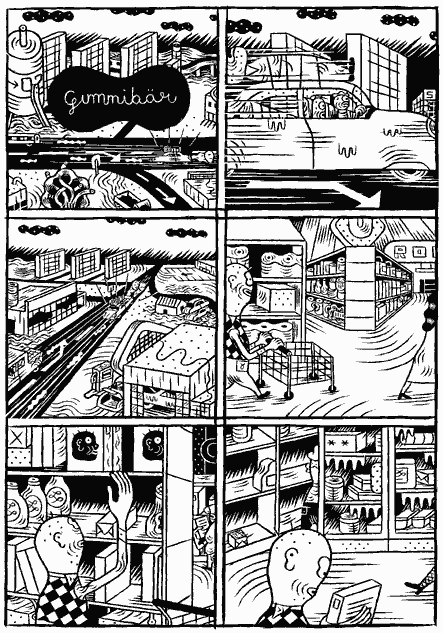
You can think of panels as little windows where characters and objects are going about their businesses, and the viewer is an objective observer of these phenomena. Lots of comics work this way: Yuichi, Brunetti, Seth, Robel, etc. - the proscenium arch modality. Space works in an almost direct analog to the way we think of it in the real world: there's a specific, solid environment you move around in - it has a materiality that is unchanging. It's related to film and theater: camera angles are often employed, characters act out their parts, lighting effects are used, etc.

There's another way to craft comics, though - a subjective, internal mode where our relationship with the interior spaces is more participatory, where simulating our physical environment is eschewed in favor of more formal concerns of design and rhythm. Lasky, Santoro, me, etc. - the illuminated manuscript modality.

It relates more to literature or design than film. Characters and objects are dealt with as abstract signifiers or compositional elements and the "real world" is represented as a linguistic or aesthetic construct - full of form but lacking detail.

Rhythm exists, not as a part of the action happening within the frames, not by the movements of characters, but by the grammar of the page.
In my head, I keep trying to make it binary, to put people into separate camps, but this is a Rube Goldberg medium, and there are components that are imagistic and components that are ideational in virtually all comics. Because it is both a static (unlike literature) and temporally involved (unlike drawing or painting) medium, space and time can work as a closed system or relate to how we experience movement outside of the page.



31 comments:
Jason, really compelling idea you've begun to explore here. But could you expand a bit on how actions and characters can be separated from the grammar of the comics page?
Sure. For instance, in this page by me, the text carries the narrative forward (previous page is this). The movement exists as text broken up rhythmically, interspersed with imagery that, cumulatively, relates to and adds to a theme that's being explored.
Though it's not something I like, Red Meat is a perfect example of the illuminated manuscript version - the text carries the gag, sets up the chain of action, and the images provide a dry counterpoint.
Some of the work in the Abstract Comics anthology fits within this category, too, but a lot of it is just a hyper minimalist version of the proscenium arch way of doing things.
The more typical way comics progress is by referencing a world that exists within the confines of the panels and the people moving about within that world. Supposedly for Cerebus, as an example, Gerhard built models and used them as reference points for the "place" where the Aardvark is situated. Seth, as another, has built models of his fictional town of Dominion for Clyde Fans(and a history for the town, too). So a place (Gotham, Metropolis, NYC) is built to house the story and there are figures moving convincingly ("realisically") within this place.
Eisner is a good hybrid - within the Spirit there are definitely filmic touches, but his design sense is really strong, too, and there's a lot of dismantling the fourth wall.
Herriman is another great hybrid, I think. Coconino County exists, but characters and backgrounds move around fluidly and the text as poetry carries the strip.
The binary I'm drawing, maybe, is between system-building and world-building. Each allows different types of ambiguity.
Btw, Derik Badman has a great post about "pictureless" comics on his blog from several years ago.
this is a tangent, but i hate when the 'breaking the 4th wall' is sincerely referred to as an 'event'
1st of all the 4th wall can't be broken n e ways ... 'breaking' it (the event) is such a humorless thing
i guess i mean sometimes this is the case ... like it's something to watch out for
"Space works in an almost direct analog to the way we think of it in the real world: there's a specific, solid environment you move around in - it has a materiality that is unchanging."
this note stops me up. i have a hard time parsing the solidity of my external environment, versus the internal in life. they co-exist. any fragility in one is mirrored.
rege seems to be on a big metaphysical tip about this lately. dream life and real life being flexible, interchangeable. he is doing interesting work, but the work touting the message isn't as mysterious as the reality.
(nor is he saying it is, but isn't it equally trapping and transcendent to make work about it?)
i remember clowes talking about word balloons being the 'mental' side of experience, the rest of the drawing managing the 'physical.'
this seemed like a good trick, and effective method, a good 'drawing cue'. also a shade 'easy'. i'd put more faith in ware's constant disposition of productive turmoil.
placing faith in signs to mimic, not owning up to a love of the signs themselves? somewhere in between? the 'comics balancing act' which i think our best creators succeed at. ........hankiewicz! praise be to thee....
...a problem with the 'comics world' maybe. our heaviest practitioners are shaking one fist at perceivable reality, while the other makes 'solid' work to back it up in a way both potent and fragile. then nostalgia rears it's head, more digestible than an agenda of existential sweating. and then all the talking starts.
heave. ho. heave. ho.
@facebook - yeah, sorry - I should'nt've busted that dumb phrase out.
@Vomits - hmmmm - I meant that there is a way to deal with space as a literal, external thing and a way to treat it more symbolically.
I'm sure most people have some degree of disconnect between the interiority of their headspace and the material reality that seems to go on around them unperturbed. It's all one big, gooey mess, sure, but there is a "me" and a "not-me."
"i remember clowes talking about word balloons being the 'mental' side of experience, the rest of the drawing managing the 'physical.' "
This is kinda what I'm talking about - I think this seems to be the accepted wisdom, but there are other ways to make comics.
"placing faith in signs to mimic, not owning up to a love of the signs themselves?"
signs can be beautiful but arbitrary in their relationship with what they're representing.
Viva la Hankiewicz!
I'm interested in how rendering styles affect the reader's perception of both the characters and their environs. I don't think it's a black and white distinction between objective and subjective time/spaces in comics. There is a ton of grey area and the artist can move up and down that scale for effect. Look at Wilson for example.
Makes sense, Jason. I think it was your use of the word "grammar" that threw me off. It's not that these "proscenium" comics don't employ a grammar, but that they are not primarily created around the grammar of the page's form.
I think the binary terms you've offered of system vs. world-building are particularly useful for this discussion.
It's interesting to me that you put Yokoyama on the world end of the spectrum and Santoro on the system end. One of the things that is so compelling to me about TRAVEL, say, is that though Yokoyama is referencing Tokyo (and Japan beyond the big city), like Seth might Palookaville, he seems to locate the way that Tokyo reflects the form of panels and pages that he has chosen as his tools as a comics artist. As if the world he reflects inhabits the form rather than using the page in service of an exterior environment.
Santoro is more in between, maybe, but he's very interested in abstract structures and layouts and this seems to drive the narrative more the the physical movement of characters in an objective environment. His mark making breaks down the suspension of disbelief also.
I feel like Yuichi is more similar to the minimalist pro arc school exemplified by the ab comics antho: The characters aren't convincingly human (his intention) but there is a mechanical causal system that is it's own world that seems very material and exterior.
Yuichi is very precise in his manifestation of his world while Santoro is much looser.
I think Derik Badman has written about differences between realistic Storeyville backgrounds and ethereal Cold Heat world. I can't find it - but he got what I was going for - that I remember.
I like that old Warner Brothers cartoon where the magician and Bugs are on stage - and the backgrounds just change color to highlight the emotion of the scene. Comics and animation let you do that easier, I think, than film - which is what most comics styles have evolved from. Why not change the environment? Look at Captain Easy sundays - it's very abstract. He chooses what to depict
Interestingly enough it was a proscenium stage in that Bugs Bunny cartoon.
Good one - Badman ideas here
fleischer and iwerks
trump
warner bros.
~any day of the week~
i love the 'new engineering' stories with mechanical arms reaching from beyond the panels, building the environment.
would like to see a Y.Y. comic with those mecha arms 'pushing' the characters around.
he defeats his 'anti-humanism' strategy, not by maintaining 'neutral facial expressions' (tao lin) or 'basic' movements, or even 'weird' costumes (all of which he does), but by giving his characters agency of movement in the first place.
can we talk about chester brown?
his transition (in regards to movement, space and consciousness) seems huge, crucial and in this instance, topical, similar to hankiewicz.
underwater seems like the 'fulcrum point', with louis riel being the thorough excavation of that terrain. he is heads and tails above other creators in respect to these topics.
no one talks about chester and yokoyama in the same sentence. i am changing that RIGHT NOW.
WE CAN ALSO TALK ABOUT BRUSH CONTROL. can you believe those riel panels were drawn 7x7" with a brush??
nib for the lettering
FEEL IT
LIVE IT
DO IT
I don't know that it fits with the original post but I have to say I totally agree about Underwater, it was so beautiful and future-thinking. Still in awe of it.
DYLANNNNNN!!!!!
YOU KNOOOOOOW
no shit, underwater
is
the
shit
OVERBEA, PLEASE COMMENT ON UNDERWATER, besides a general approval. i want some heady shit here, CONNECT IT.
bust it OUT
if underwater is 'active'
is yummy fur 'passive'?????????
~~~just throwin' that out there~~~
The move from the "proscenium arch" realistic space to the subjective... whatever you want to call it, more ethereal, less three-dimensionally modelled space seems very similar to changes in painting in the late 19th/early 20th century. The shift that happens from Impressionism to post-impressionism, where a shift in ideas of how to render reality (impressionism) becomes a shift in what can be rendered and how space is used (until you get to the abstract expressionists and the foregrounding of the surface).
I think that makes sense... I was down in DC at the museums so painting is on my mind.
Thanks for linking to that post on Frank's work. Reading it, I kind of feel like I didn't write it. I've gotta get back that... passion for writing about comics which brings out those ideas.
really good appreciations, Derik - it's hard to keep up the steam.
I think the mode of art you're talking back is partially hearkening back to an earlier, symbolistic, non-illusionistic idea of space and form. Linear perspective is a way of approaching spatial relationships that we have grown up with and internalized.
Underwater... Riel... yes. What started me liking Chester was reading Ed and seeing how he merged wildly different plotlines together. The fact that "The Man Who Couldn't Stop" had a butthole that was a portal to another dimension where they had no toilets was awesome.
Underwater's great because it's exploring the idea of subjective space and how humans develop their concepts of a solid, material world, how it's this gradual accretion of substance and form. I never saw that stupid movie with Val Kilmer, but I read Oliver Sacks' account of the man who'd never been able to see and had an operation that gave him his sight. What I remember is that the man couldn't parse the visual information, he had no experience with the systematizing that occurs slowly and organically in babies.
had similar experiences myself with sense of smell...
Oops - meant to post this, too:
"I’m interested in creating space in my narratives and by that I mean building space in a very clear architectural sense. But I hide itvwithin the framework of the story so that it is invisible. It’s like a church in a way. One is aware that the stones are arranged artfully, but there is generally a very basic, simple formal plan that all churches follow. They all look alike they just have different
ornamentaion, right? Christian churches, I mean. And comics are similar if you can imagine that the page, the two page spread stays the same. You can arrange the panels anyway you want but you still gotta move the reader through the story. Well, I’m interested in creating very deliberate lines of sight within the narratives. It
looks simple and almost rigid, but it allows me to inject my spare lines and forms into a very solid space, a very real “area”, like a nave in a church corner – there is “space” in between architectural elements that pushes and pulls one’s eye around."
http://talkingwithtim.com/wordpress/2008/11/05/frank-santoro-on-cold-heat-blogging/
VOMITS VOMITS said...
"i love the 'new engineering' stories with mechanical arms reaching from beyond the panels, building the environment.
would like to see a Y.Y. comic with those mecha arms 'pushing' the characters around."
This is a very theatrical device, somewhat similarly used in some films, for example Shinoda's astonishing "Double Suicide" (1969)
Also relevant: it amazes me how quickly my daughter understood symbols and cartoon iconography. She can look at the most minimal drawing of a cat and recognize it as a "mrow." And today she saw some flames painted on the side of a tattoo parlor and said "hot." it's wild how soon we start to form our realities in terms of symbolic meaning.
She's a year and a half old...
having met jason's daughter, i would say she has already mastered gesture and modern dance, street performance, with a minor in mime. she's a regular jerry lewis. i mean, jerry seinfeld. i mean, gilda radner.
....but i'm training my children to comment on contemporary comics!
this makes both me and my kids healthy and happy. we live in a house with two cats and our diet is steady. sometimes we draw comics, sometimes not. we form opinions over dinner.
a great warmth can come from the resonance and memory of a well played cello. all of my children know the in's and out's of that resonant tool.
similarly, your average comic strip, with it's textures, abutments and enclaves, is ripe for study.
but lo, please punish your children by directing them to this blog and requesting that they parse it for ease of reading, specialist imagery and grown joy.
a well-grown adult can get nothing but good merit from a perusal of the topics presented, but surely a child will collapse into sudden, painful fits.
this is as it should be. thank you.
if i want to see a smile, i bring out a hula hoop
~~~take a rest, you rubes!~~~
Fiato d'Artista d'Bil Keane, è pussies!
damn, yeah.....
Post a Comment