
When I write essays I often lose track of what I originally set out to say, so I'll say it right now: metaphor is essential to our practice.
I hadn't found a clear backdrop against which to frame this argument until just this moment. Looking through scrap paper I found in a recycling bin I came across 'Against Interpretation' by Susan Sontag. I'm 9 pages into it. Sontag, like the writer Tao Lin, prefers the concrete world to the abstracted world. Some of her arguments might resonate with angry commenters on this blog:
'In a culture whose already classical dilemma is the hypertrophy of the intellect at the expense of energy and sensual capability, interpretation is the revenge of the intellect upon art.'
She goes on:
'Even more. It is the revenge of the intellect upon the world. To interpret is to impoverish, to deplete the world -- in order to set up a shadow world of "meanings". It is to turn the world into this world. ("This world"! As if there were any other.)'
I want to switch gears very quickly. A hazily remembered exchange between CF and a man in the audience:
CF: When I draw these characters, these comics, it's like I'm actually experiencing these adventures.
Man: But you're not.
CF: But I am.
Man: But you're not.
Switch to my early posts on this blog embracing and exaggerating CF's logic - the subjective over the objective - in order to a) talk about comics using natural language (working around the limitations of the words 'moving' and 'static' to describe the effect of consuming and creating comics) b) counterbalance what I felt was a bias against interpretive/subjective language.
Switch to 'Art History' and a peculiar yet obvious historical subplot: the rise of the 'art vs life' binary and the resulting advocacy of 'life' over 'art'. Patently 'artistic' gestures like 'to draw' and 'to paint' seem quaint when compared with 'to destroy' (Dada), 'to walk' (Situationism), 'to be' (Happenings, Fluxus), 'to think' (Conceptual Art), 'to relate' (Relational Aesthetics), to shop, to appropriate, etc.
Switch to the spine of a book titled 'Allan Kaprow: Art as Life'.

Susan Sontag writes, 'Interpretation, based on the highly dubious theory that a work of art is composed of items of content, violates art. It makes art into an article for use, for arrangement into a mental scheme of categories.'
Comics, like interpretation, seems to threaten the sanctity of the image:
'[Comics], based on the highly dubious theory that a work of art is composed of items of content, violates art. It makes [the image] into an article for use, for arrangement into [iconography].'
For the 'art comics' creator this description seems insensitive if not cruel - it denies the image freedom to be 'just an image', to escape context, to escape meaning. Can we be so insensitive as to reconfigure, in Susan Sontag's words, 'the pure, untranslatable, sensuous immediacy of some [...] images', into mere 'items of content'? But translation occurs across every panel border. Comics runs on translation. When images are itemized, arranged, and categorized, their purity - their one-ness of image - is not lost, but becomes hidden.
'The old style of interpretation was insistent, but respectful: it erected another meaning on top of the literal one. The modern style of interpretation excavates, and as it excavates, destroys; it digs "behind" the text, to find a sub-text which is the true one.'
The reader/viewer experiences comics 1) as physical matter (static images on concrete pages/screens) 2) as hidden matter (shifting iconography representing a single coherent universe). These two experiential states occupy two depths of field - 'inner' and 'outer' - and the reader/viewer is limited to focus on one and ambiently perceive the other. Can comics conflate these two worlds - to represent itself in an unaltered form? No. Representation is embedded within comics. A color field may represent nothing in an image (as printed matter) but upon reading (as a word in a sentence) it represents something. If a series of color fields cannot be 'read' they are not comics.
For example:
The word x does not have a fixed meaning. In the sentence, 'x was so cash', x represents [something] because x is read. In the sentence, 'x x x x x x x x x x x x x x', if you are like me, you saw a static field of x's and did not say 'x' 14 times. If 'x x x x x x x x x x x x x x' is not read (experienced linearly), the viewer does not experience a single hidden coherent universe (in which each element adds to or modifies one's interpretation of this universe).
'In some cultural contexts, interpretation is a liberating act. It is a means of revising, of transvaluing, of escaping the dead past.'
One could describe the static nature of comics, combined with the 'recording' nature of their creation, as a static recording, or a dead past. Transvaluing in comics is seeing through the marks on paper - not negating the marks - but transfering value through them, into the universe they represent.

70 comments:
'metaphor is essential to our practice.'
I don't think this is true at all.
In my poor reading of that Sontag piece, I take away a strong idea: why make art that's metaphor based at all? Why not just write an essay on a blog? The open endedness of art is its strength.
I like Bressons movies---some people say the dialogue and acting is stilted...'unrealistic.' But to me they just point to the unreality of most art. Metaphors are like that...they're cheap and easy and tack something onto a thing where there isn't anything---rather, where nothing needed to be tacked on anyway.
A drawing of a person in a comic ios a 'metaphor' for a human? OK. So what? There's more to it than that.
I'm afraid to feel
WOW! This is the exact dual sentiment in my head whenever I either take in or create anything:
CF: When I draw these characters, these comics, it's like I'm actually experiencing these adventures.
Man: But you're not.
CF: But I am.
Man: But you're not.
'If a series of color fields cannot be 'read' they are not comics.'
To an impatient, fussy reader sure.
[trying to hump Austin's comment, with which i agree]
not verbally pronouncing each 'x' 14 times in your brain is not the same as not reading 'xxxxxxxxxxxxxx' if by reading you simply mean interpretation. i'm also not sure why reading has to mean experience linearly. it may be true that most readers will have a hard time distinguishing between 'xxxxxxxxxxxxxx' and 'xxxxxxxxxxxxxxxx' but 'x' is probably read much differently than 'xxx' or 'xxxxxxxxxxxxxxxxxxxxxxxxxxxxxxxxxxxxxxxxxxxxxxxxxxxxxxxxxxxxxxxxxxxxxxxxxxxxxxxxxxxxxxxxxxxxxxxxxxxxxxxxxxxxxxxxxxxxxxxxxxxxxxxxxxxxxxxxxxx' right.
to say nothing of the drama of an x as a placeholder to begin with: x as sex symbol, triple x as a rating or category, a series of xs as a fence, an x as the easiest way to divide a square, x as a black eye, etc, 'x was so cash' as a lot funnier and more intriguing than whatever x stood for as being so cash (unless it was cash). u see?
how imprisoned in words are you really
drop
If you're referring to the interview with Dan Nadel and CF at SPX a couple years back, you're misremembering the quote. The mp3 is probably on the internet somewhere but I remember distinctly Christopher saying "It's not the same thing."
@Austin 'A drawing of a person in a comic ios a 'metaphor' for a human? OK. So what? There's more to it than that.'
Isn't this a rather important aspect of the drawing? It is not the full extent of it - it can't be replaced with the word 'human' without losing the power of the image - but it is undeniably a level of experience of the drawing.
'the unreality of most art'
An entirely subjective reality. A song I love when i'm 18 speaks the truth in a way it never will again. '("This world"! As if there were any other.)'
'To an impatient, fussy reader sure.'
Yes, I am advocating comics exist on two levels and on one level -an individual level - it is an experience. An impatient reader ceases to hold a comic once they cease to engage with it as a reader.
@preteen 'how imprisoned in words are you really'
If I am correct in identifying this anon, you are mired in art comics, are you not? Words are threatening when they seem to subjugate the image to 'illustration'. To experience an image as metaphor is to threaten those marks you hold dear. But in seeing through the image to meaning the image is not lost or ignored. How is this even possible? To look at an image and say, 'this line means this' does not suddenly destroy the line itself.
@Tee See Yes Was there a back and forth at first - with the man taking an objective stance and CF taking a subjective stance?
in that CF interview (which is hard to find online now) i remember him being centrally frustrated with the compromises between life and art. he seemed to be into transcendence, energy release...but i think the statement blaise is paraphrasing was followed by a frustrated cackle at the compromises one has to make to balance normal life and ecstatic life. art as conduit/practice.
@austin
bresson is a super good thing to bring up
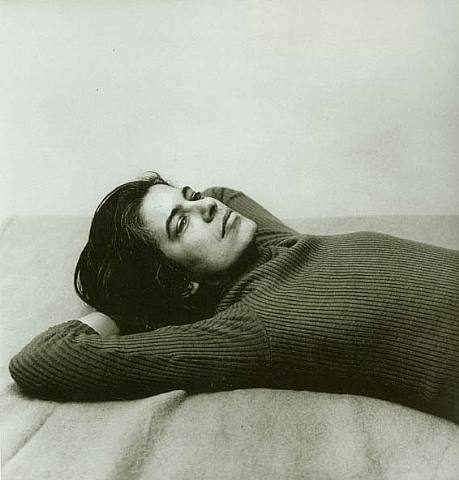
Sontag's lookin pretty chill, probably feeling really concrete at the time
@blaise
1.
i'll take that answer as 'very'
2.
no but seriously it seems as though you have to explain every gesture if not to us then to yourself. conversely you also seem to value peace, isolation, simplicity (am i reading too much into you) and maybe aren't a party bro, so i wonder how much your ideal prison cell is a room explained rather than a room of endless silence/noise...what do u think?
3.
kinda just want to 'die' in life over and over and not call it such, u don't huh?
4.
what's my name? u can heavily anagram it if ur interested in my anonymity or better yet refer to something only u and i would know of...just curious if ur right ;p
'An impatient reader ceases to hold a comic once they cease to engage with it as a reader.'
Frankly, that's their personal tragedy.
'It is not the full extent of it - it can't be replaced with the word 'human' without losing the power of the image - but it is undeniably a level of experience of the drawing.'
I always read those Chris Ware statements about how he wants the character to experience the drawings of characters as notes. Not to be bogged down with a lot of unessential info on the face.
That's fine and close to what you're talking about? But there's other ways of making comics. One doesn't dictate the other.
that should read:
I always read those Chris Ware statements about how he wants the READER to experience the drawings of characters as notes. Not to be bogged down with a lot of unessential info on the face.
I think you're misinterpreting sontag here. I don't claim to be a sontag expert, but i've read some of her work. I think her argument here is aimed at critics that take "art" and make it something mystical through interpretation. Critics that place art on a high pedistal because it has transcendent value.
in this statement:
"'[Comics], based on the highly dubious theory that a work of art is composed of items of content, violates art. It makes [the image] into an article for use, for arrangement into [iconography].'"
you've really bent up the words into something totally unrelated.
and the following statement:
"For the 'art comics' creator this description seems insensitive if not cruel - it denies the image freedom to be 'just an image', to escape context, to escape meaning."
goes against sontag's statement
"The function of criticism should be to show how (art) is what it is, even that (art) is what it is, rather than to show what (art) means."
Sontag is saying that an image is and should just be an image, with no hidden special meaning.
I don't think that sontag would argue that reading a comic, or watching a movie is the same as interpreting it. This statement by her seems to clarify that for me:
"Of course, I don’t mean interpretation in the broadest sense, the sense in which Nietzsche (rightly) says, “There are no facts, only interpretations.” By interpretation, I mean here a conscious act of the mind which illustrates a certain code, certain “rules” of interpretation."
Comics are moving, not static, i think a mistake here is the attempt to critique comics panel by panel, as painting.
you misread someone who didn't believe in interpretation. pretty dumb
@preteen 'no but seriously it seems as though you have to explain every gesture if not to us then to yourself'
What gestures have i ever explained? I am attacking critics who dismiss any 'use' of the image as a debasement of the image. Utilitarian employment of the image does not necessarily destroy the image just as employers do not necessarily destroy their employees. If the critic holds the image to be truly powerful why is interpretation perceived as such a threat?
@noel 'By interpretation, I mean here a conscious act of the mind which illustrates a certain code, certain “rules” of interpretation."'
Iconography, representation, these reveal meaning through coded language. See Jason Overby.
"Iconography, representation, these reveal meaning through coded language." -Blaise
Sontag's argument isn't against Iconography or representation. She actually praises cinema, which uses a visual language, coded if you will, like comics.
her argument is against critics that place concrete meaning on art, where there is no meaning.
you keep mistaking her use of the word "interpretation" and you are trying to apply it to the act of reading comics.
The experience of reading a book, comic, or watching a movie, is vastly different from what sontag is attacking as "interpretation."
here's a clear example of her definition of "interpretation" from the essay:
"Ingmar Bergman may have meant the tank rumbling down the empty night street in The Silence as a phallic symbol. But if he did, it was a foolish thought. Taken as a brute object, as an immediate sensory equivalent for the mysterious abrupt armored happenings going on inside the hotel, that sequence with the tank is the most striking moment in the film. Those who reach for a Freudian interpretation of the tank are only expressing their lack of response to what is there on the screen."
Note that Sontag has "interpreted" (by your definition) that there is an image (Iconic) of a tank in a street. But she chooses not to "interpret" (her definition) that the tank is a phallic symbol.
This is the difference between your definition of interpretation and Sontags.
This is the basis of my disagreement with your statement, you've bent the meaning of Sontag's essay into something completely irrelevant.
@Blaise:
it does sound as though you're going for what someone referenced Sontag describing as the Nietzschean interpretation - a total interpretation. That would be my guess, on first read.
Jumping aside from these things for a moment, I think this is one of your most well-written posts, though I do think the example with the 'x's was unnecessary and more confusing than illuminating (though considering the repetitive nature of the example it is perhaps fitting for a repetitive exemplar to be itself repetitious).
i think you're on to something here. i'm looking forward to reading this post and everybody's discussion again.
@noel are we entering into meta territory (deja vu all over again) ...
i am interpretting 'against interpretation' to fit my own purposes
noel: 'Note that Sontag has "interpreted" (by your definition) that there is an image (Iconic) of a tank in a street. But she chooses not to "interpret" (her definition) that the tank is a phallic symbol.'
wikipedia: 'icon is also used, particularly in modern culture, in the general sense of symbol.'
interpretation is not required to see the filmic image because 'not reading' is not an option.
@zeroreference i'm not sure about nietzche; thank you; i agree re the x's
"are we entering into meta territory"
Is that what you guys call each others' assholes these days?
can we out each other please?
jesse mcmanus?
Nabokov might be an interesting wellspring for u Blaise as one of his primary activities in most of his books was mixing metaphors and castrating Freudians. noble shit
@zeroreference
'Jumping aside from these things for a moment'
referencing the original text, lol!
i'm dead
fuck outing
hide or die
Four Loko, Free Love, coincidence?
This post and some of Frank's recent posts about naturalism in comics touch on something I've been thinking about lately. The idea of "natural cartooning", particularly in the case of Ben Jones' b&w strips. Like Blaise mentions, most comic drawing is iconographic. The cartoons represent either real world or ideal subjects or objects. When I look at Ben Jones' cartoons I get the impression that they represent only themselves. They are exactly what they are. Same goes for a lot of post-FT, art brut cartoonists in art comics right now. The image represents only the process of it's creation, the "world" of that act.
That world happens to be a great jumping off point for semi-abstract and open ended narratives, NINJA being maybe the best example. NINJA is the best narrative ever accomplished in art comics. I don't think anyone ever talks about that particular aspect of that work. The structure is totally organic yet robust and it maintains the sense of immediacy suggested by it's lines. There is still hope.
Can anyone (Austin maybe?) point me to some solid reference material on primitive and naive cartooning, ancient graffiti, etc? Mostly pertaining to the analysis of the thought processes behind it's creation?
@ian 'When I look at Ben Jones' cartoons I get the impression that they represent only themselves.'
the lines represent something other than themselves or else each panel would only represent itself
ben jones drawings are locked into a rigid code - this set of lines translates into this character
'again', i am not proposing a 'fun home' approach - the lines remain lines; as translators we are seeing two texts at once
I've tried really hard on occasion to build comics where the imagery resists an easy relationship with something it symbolizes. See this, this, or this.
That is one of my biggest goals - to create strips that aren't just comprised of units of information - where the meaning is mysterious to me.
"interpretation is not required to see the filmic image because 'not reading' is not an option."
Not reading is not an option of a representational drawing either ( or a comic). you would have to teach yourself to unsee a representational image, just as you could theoretically teach yourself to see a movie as moving patches of color. A drawing, a movie, a sculpture, none of these are natural. Each is understood with preconceived experience.
I have very early memories of not understanding an image on a t.v.
^that was me
@Jason
i generally think you hit your goal pretty well, better'n others
@N
first movie i saw: Song of the South, kind of blew mah mind
@jason 'as i echo over the sidewalk the many instances combine ... to form me'
'Interpretation [is] based on the highly dubious theory that a work of art is composed of items of content'
true, your 'many instances' are not discrete 'items of content' in 'reality', but on the comics page they are
@noel you're right re reading re film / tv / comics
i'm not sure what i'm trying to say ... possibly something like scott mccloud says about closure, how it is different in comics
@a fan
Song of the south still blows my mind, you should check out the Splash Mountain ride at disney world, one word: ANIMATRONICS!
http://www.youtube.com/watch?v=e-IfXrAHSKA
what does it all mean? :(
@B I'm sometimes more successful than others and especially with the Solipsistic Cosmology set, which was intended to be partially narrative.
true, they are discrete items on the comics page, but that doesn't mean there is an intended or specific meaning. Any static thing - drawing, painting, sculpture is a unit, but it can be enjoyed sensually, without having to be attached to any semantic encoding. I just want the meaning to be more open, not like words, not like Ware. Unlike Sontag (or former versions of myself), I don't think there's anything really wrong with a Ware-ian hard ontological system to make comics with, but it's not the only way to do things. I find being tied to propriety or notions of correctness or arbitrary definitions of "comics-ness" restrictive and unnecessary.
I've been watching the OG Star Wars trilogy with my daughter lately and enjoying it far more than I have in years for the visual pleasure and exoticism, not the dopey story.
@Jason
whoa, i just watched 1st Star Wars and Empire Strikes back for da heck of it and i can't believe how light the story is (i remember it as EPIC) but yes, the fx and flashing lights and masks and so forth really seal the deal
@N
scary as fuuuuuuck! i did that at disney world and i peed. of course i was only 10, and that was 3 years ago
is anyone else creaming themselves for tron: legacy; i am
@jason 'I find being tied to propriety or notions of correctness or arbitrary definitions of "comics-ness" restrictive and unnecessary.'
you're talking about societal definitions of comics ...
you once said you had an interest in exploring / pushing the bounds of what comics 'are' ... where did / do you see the bounds and where did they originate?
dan nadel via kevin huizenga: 'applying words like "literature" to comics is less about how well or not the label fits, and is more about speaking the language one needs to speak to gain institutional support (major gallery collections, major library collections, grants, academia) etc'
i'm not proposing this stuff to restrict people; my original spark / train of thought for this essay was a reaction against mainstream dismissal of representation in art. People who nostalgize the avant garde (including people invested in alt comics (including 'me' in the not so distant past / present)) are prone to dismiss representation in lieu of the concrete/conceptual - 'the image', 'the list', 'the book', etc
mainstream helvetica ad campaigns are concrete / conceptual
net art is concrete / conceptual
vvork is ...
etc etc
even the 'no brow' tendency, as i have witnessed it, is concrete / conceptual
'it is what it is, man. it's not for me to interpret anything beyand that.'
duchamp 'invented' concrete / conceptual and warhol popularized it
'check out this [non-art object]'
'what's it about?'
'it's not about anything. it is what it is.'
i have been reading interviews with artists who dislike duchamp and it's really refreshing ...
concrete represent
You kids get the hell off my wife's lawn
@Nadel Nadel
snorted coke onto my keyboard, thx
Does anyone post or make work with particular audience members or viewers in mind; have you ever done person/institution targeted work with no other audience in mind?
@Telemarketing yes
@young lions
like, just 1 or 2 individuals who aren't you, not even a mini-scene?
duchamp is good, what the hell dude
requested:
please keep talking about splash mountain
that video is scarier and better than most things
Cheers,
Jacque
"you once said you had an interest in exploring / pushing the bounds of what comics 'are' ... where did / do you see the bounds and where did they originate?"
Probably in my own brain. I feel like I'm just reading comics & interviews & message boards & blog posts and aggregating this information into the-state-of-comics-today. I'm a die-hard windmill chaser.
Really, though, I think Understanding Comics is partially responsible for creating those boundaries. After that book came out, I started to see more talk about the formal properties of comics, how this or that was/wasn't exploiting the properties of "the medium," etc. There became a Platonic Ideal of what a comic was vis a vis the-way-comics-work, and people strove to make this type of comic,i.e, discrete objects moving through discrete time with a certain rhythm, ideally using a flattish two dimensional perspective. Ware was a huge influence just by virtue of how his comics work. People were dredging up Blackbeard's book and decrying camera angles. Flatness, simplicity, clarity were what cartoonists strove for.
I know you're not trying to establish your own orthodoxy. There's this push-pull, cyclical thing that happens where something is cool, then it's lame, and then it's cool again. New generations are continually reacting against the previous ones.
I talk a lot about Duchamp, but it's for this specific context. Lots of comics-folk are willing to embrace "Aht" but others think it's a lot of pretentious baloney. There is a tendency (first witnessed by me in my younger self) to be anti-intellectual, call bullshit, steer clear of the anemia of "fine art," and I want to play devil's advocate to that. Value is relative, but I don't want to champion Peanuts ahead of ideas that clang around in my brain for years. Of course, Duchamp is another type of orthodoxy. Following him is not going to lead anywhere, but he was amazing. But his work is not satisfying in the way fiction is. It's not escapist and doesn't move us through time as enjoyably. That used to be my criteria for good, and I need that directness of apperception sometimes, but other criteria have led me to work that has nourished me more over a longer period of time.
There is a bias against fiction or even diegesis in art, and these Duchampian viruses have forced me in this direction occasionally, made me want to steer clear of "craft" and go for something more immediate or concrete, but stories have some carthartic value, too. Even if they will always be somewhat programmatic, the making and reading of them can actually lead to discovery about the "real world." Representation can be very binary or much hazier.
@jason i think i am interested in the hazier. i think partly this is because i want experiential art, and viewing the image as a kind of 'magic eye' transformss it (at least, via this analogy) into an experiential mode of perception. i think this goes on all the time when i read comics after a few pages - once the momentum of reading picks up - everything starts flowing through peripheral vision - periferal vision takes over.
i like this description of reading comics because it is experiential (high art, in my mind, and not just 'op art' tricks) via representational drawings (which neither you nor austin entirely escape from, though i love the struggle).
this magritte painting is like rothko (experiential) but via representation
Are you using "experiential" to mean the ability of a work of art (specifically narrative, mostly) to suck us into its environment - like that fake CF quote? To provide us with a space to inhabit for the duration of our time with it? We've talked about this before, I'm sure - our desire to create these spaces. I fail at this usually, unless you could consider wrestling with an idea the creation of a diegesis inside the mind of the reader/viewer? I'm mainly not creating these spaces, but instead I make objects like an Amy Hempel story or Finnegan's Wake (though not anywhere near as beautiful as those things).
And I think you're right that you can use familiar (or easily understood) symbols as discrete objects within a narrative and not create a definitive meaning (see Denis Johnson, Terrence Mallick). I'm just no good at that. The haziness of my representation is in the how, not the what.
And, yeah, Austin and I are doodling de Koonings - there is rarely elegance, the struggle is the drama - the creation in the viewer's mind of the act of process is often the narrative.
But that Magritte is dangerously close to Dalí, kitsch city, working with what you assume are easily understood forms instead of letting the forms also be murky.
no, i mean experiential like rothko or to a lesser extent op art and magic eye books
'trippy'
where the eye kind of loses focus and the image immerses / surrounds rather than stays flat on the page
i agree re kitsch re magritte
i guess that specific painting is one i've seen a lot and my memory of that experience is sort of immersive
like the ganzfeld
The Ganzfeld effect (from German for “complete field”) is a phenomenon of visual perception caused by staring at an undifferentiated and uniform field of color. The effect is described as the loss of vision as the brain cuts off the unchanging signal from the eyes. The result is "seeing black"[1] - apparent blindness. The Ganzfeld effect is the result of the brain amplifying neural noise in order to look for the missing visual signals. The noise is interpreted in the higher visual cortex, and gives rise to hallucinations. This is similar to dream production because of the brain's state of sensory deprivation during sleep.
well they got the evasion and equivocation just about right but someone is doing a pretty weak blaise impression
Ok, cool, gotcha. That's what I originally assumed you meant, but I got confused. Yeah, I'm really into that - so much noise that it just becomes nothing, background.
I think your work (the minis, specifically) often works totally that way. Like 4:32 where it envelops your perceptions and you participate with it to make the "thing." no forward motion, not going anywhere, no meaning to arrive at, just a bath to be immersed in.
what is 4:32?
a typo
more nudity, less sex
one more second of noise
ce n'est pas un œil magique
<
<
^ win
for some reason I have this bookmarked, cut through the first few minutes and it gets to the entire dan/cf interview. i havent listened to it in awhile, so i cant talk about the quote...
http://podcast.inmotionhosting.com/ISR130.mp3
@phantasmosis thanks, but the quote i used comes from a different conversation
a conversation that only exists in mah brain.
""Ingmar Bergman may have meant the tank rumbling down the empty night street in The Silence as a phallic symbol."
I was thinking as I was reading your discussion that the whole thing must just be an anti-Freud screed. I think you're right to call her on trying to draw a rigid line between Freudian interpretations and other kinds of interpretations, Blaise...especially since, in that quote, she seems to think that interpretations are only valid if they were intended by the author? Which is a weird way to try to go after Freud....
I love your example of xxxxxxxx to distinguish between reading and image. I've been thinking a little along those lines about the tension between the page as object and a work as narrative or whole — though, of course, the page can be read too, and the whole work is an object in some sense. I like your argument that reading the image doesn't undermine its imageness but fulfills it in some ways. Though it could be both too; that is, interpreting (or reading) the image could both contradict and complete it.
Anyway, the whole essay is just really thoughtful and fun. Thanks for posting it.
thanks, noel
yeah, it seems like freud and marx were being trotted out a lot in her day
she actually says something about good art occuring in spite of the artist's intention, in the case of the artist who embraces abstraction
'a few of the films of Bergman [...] still triumph over the pretentious intentions of their director'
*noah
like Fanny and Alexander
Post a Comment